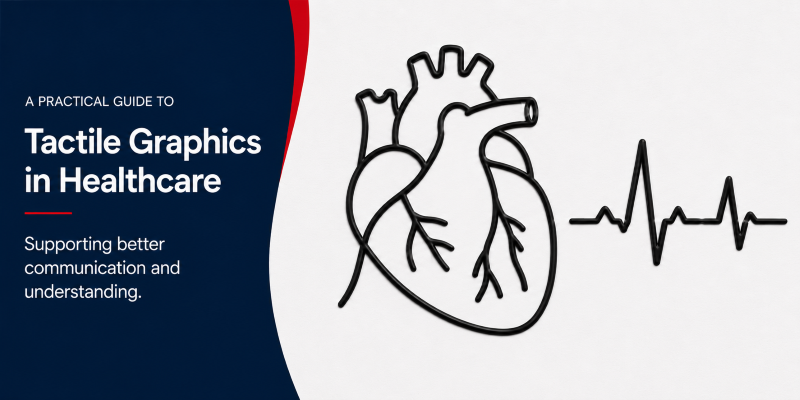
Tactile Graphics in Healthcare
Healthcare providers strive to make information accessible to every patient. While braille, large print, audio, and digital accessibility all play important roles, tactile graphics provide another way to communicate visual information through touch.
Hospitals, clinics, rehabilitation centers, medical schools, and healthcare organizations may use tactile graphics to improve access to maps, educational materials, facility layouts, and selected diagrams for patients, visitors, students, and staff who are blind or visually impaired.
This article explores common healthcare applications for tactile graphics. It is not intended to establish medical standards, replace clinical guidance, or provide recommendations regarding patient care.
Supporting Accessible Patient Information
Many healthcare materials rely on illustrations, diagrams, charts, and maps to communicate important information. Tactile graphics provide an additional accessible format that can complement braille, verbal communication, accessible digital content, and other patient resources.
Examples include:
- Facility maps
- Basic educational diagrams
- Patient orientation materials
- Wellness and health education resources
- Training materials
- Public information displays
Hospital and Clinic Maps
Large healthcare campuses can be challenging to navigate. Tactile maps may help patients and visitors understand building layouts, entrances, departments, waiting areas, elevators, and other important locations before or during a visit.
These maps are often used alongside braille signage, accessible digital wayfinding, verbal assistance, and other accessibility features.
Learn more in Tactile Maps and Wayfinding.
Patient Education Materials
Healthcare organizations sometimes use tactile graphics to accompany educational resources that contain visual information. Depending on the subject, these materials may include simplified anatomical illustrations, wellness information, medical device diagrams, or instructional graphics developed by qualified healthcare professionals.
Tactile graphics should always support—not replace—the guidance provided by physicians, nurses, therapists, educators, and other healthcare professionals.
Medical Education
Medical schools, nursing programs, allied health education, and professional training organizations may use tactile graphics to support accessible learning. Diagrams, laboratory illustrations, anatomy resources, charts, and educational graphics can help provide access to visual information during instruction.
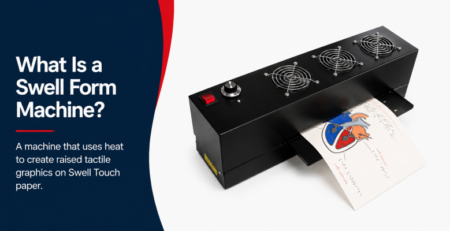
Many educational organizations create these materials using Swell Touch paper processed through a Swell Form Machine, allowing materials to be updated as coursework evolves.
Organizations producing larger quantities of educational resources may also choose the Swell Form Pro Machine to increase production capacity while maintaining consistent tactile quality.
Rehabilitation and Community Programs
Rehabilitation centers and community healthcare organizations often provide educational programs that support independent living, wellness, and accessibility. Tactile graphics may be incorporated into workshops, instructional materials, and orientation resources designed to improve access to visual information.
For demonstrations, workshops, or custom educational materials, Swell Touch Markers allow graphics to be drawn directly onto Swell Touch paper before processing through a Swell Form Machine.
Healthcare Training Materials
Hospitals and healthcare organizations also produce training materials for staff, volunteers, students, and community outreach programs. Accessible graphics may accompany safety information, facility layouts, equipment illustrations, and instructional resources used during training.
Depending on production needs, organizations may produce these materials internally or through accessibility service providers.
Producing Tactile Graphics for Healthcare
Heat-activated tactile graphics provide an efficient method for creating accessible healthcare materials. Printed or hand-drawn black areas expand when processed through a Swell Form Machine, producing raised tactile graphics while preserving color for visual reference.
This flexibility allows healthcare organizations to update patient materials, educational graphics, and facility information as needs change.
Zychem’s Role
Zychem manufactures the equipment and materials used to produce heat-activated tactile graphics, including Swell Touch paper, the Swell Form Machine, the Swell Form Pro Machine, and Swell Touch Markers.
While Zychem supplies the technology used to produce tactile graphics, decisions regarding patient care, medical education, healthcare accessibility, and clinical standards should always be made by qualified healthcare professionals and accessibility specialists.
Learn More
Continue exploring tactile graphics by reading Applications of Tactile Graphics, Tactile Graphics in Education, Tactile Graphics for STEM Education, Tactile Graphics in Libraries, Tactile Graphics for Museums, Tactile Maps and Wayfinding, What Is Swell Touch Paper?, and What Is a Swell Form Machine?.
Conclusion
Tactile graphics help healthcare organizations improve accessibility by making selected visual information available through touch. From patient education and facility maps to medical training and community programs, tactile graphics support more inclusive communication while complementing existing accessibility resources.