Applications of Tactile Graphics
Tactile graphics make visual information accessible through touch. They are used to represent maps, diagrams, illustrations, charts, shapes, and other information that may otherwise be difficult or impossible to understand without sight.
Applications of tactile graphics extend across education, accessibility services, museums, public spaces, transportation, orientation and mobility, and many other settings. The specific content and purpose may differ, but the underlying goal remains the same: making visual information available in a tactile format for people who are blind or visually impaired.
This article provides an overview of where tactile graphics are commonly used. It does not establish design standards or replace guidance from tactile graphics specialists, educators, transcribers, or accessibility professionals.
Tactile Graphics in Education
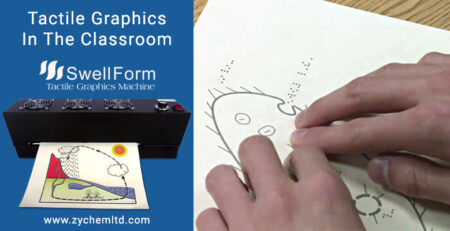
Education is one of the most common applications for tactile graphics. Schools, universities, teachers of students with visual impairments, transcribers, and accessibility departments use tactile materials to support access to information that is normally presented visually.
Educational applications may include:
- Maps and geographic information
- Mathematics graphs and geometric shapes
- Science diagrams and illustrations
- Charts and data visualizations
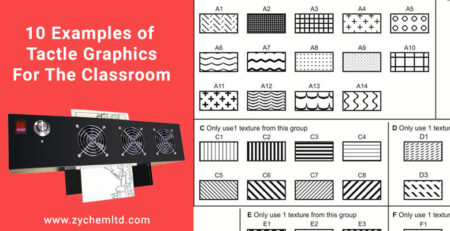
- Classroom activities and worksheets
- Accessible textbooks and instructional materials
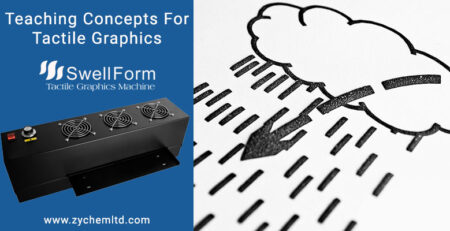
Tactile graphics can be prepared for an individual lesson, incorporated into a larger accessible document, or produced repeatedly for use across classrooms and educational programs. Heat-activated Swell Touch paper provides one method for producing these materials quickly and on demand.
Science, Technology, Engineering, and Mathematics
STEM subjects frequently depend on visual information. Biology diagrams, chemical structures, engineering drawings, graphs, coordinate systems, and geometric relationships can all contain information that is difficult to communicate through text alone.
Tactile graphics provide another way for students who are blind or visually impaired to examine these concepts through touch. They may be used alongside braille, verbal descriptions, physical models, and instruction from qualified educators.
Organizations that need to create individual diagrams or smaller quantities of materials may use a Swell Form machine. Publishers and production facilities requiring faster output at greater scale may use the Swell Form Pro.
Tactile Maps and Geographic Materials
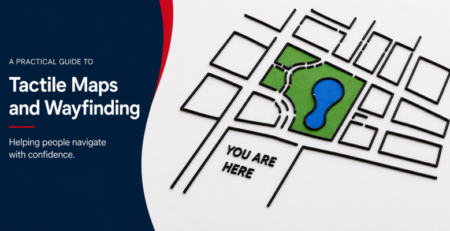
Maps are another widely recognized application of tactile graphics. A tactile map can represent geographic boundaries, routes, locations, landmarks, building layouts, or other spatial information through raised lines, shapes, textures, and labels.
These materials may be used in:
- Geography lessons
- Orientation and mobility instruction
- School and university campuses
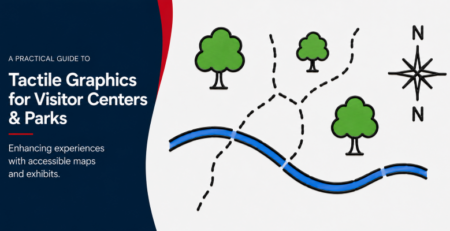
- Museums and visitor centers
- Public buildings
- Transportation environments
The preparation and interpretation of tactile maps are specialized areas. Organizations producing them should follow the requirements and guidance appropriate to their users and application.
Orientation and Mobility
Orientation and mobility professionals may use tactile graphics to help communicate spatial relationships, routes, intersections, room layouts, and other environmental information. Tactile materials can supplement direct instruction and real-world travel experience.
Because orientation and mobility is a professional discipline, the selection and use of tactile materials should be directed by qualified practitioners. Zychem supplies the paper and equipment used to produce tactile graphics but does not establish orientation and mobility practices.
Museums, Galleries, and Cultural Institutions
Museums and cultural institutions increasingly incorporate tactile materials into accessible visitor experiences. Tactile graphics may represent artwork, artifacts, historical objects, exhibit layouts, maps, architectural details, or visual concepts that cannot be touched directly.
Potential applications include:
- Tactile interpretations of artwork
- Exhibit and gallery maps
- Raised diagrams of artifacts or objects
- Accessible educational handouts
- Visitor guides and interpretive materials
Heat-activated tactile graphics are particularly useful when museums need materials that can be produced on demand, updated for temporary exhibits, or distributed to individual visitors and educational groups.
Libraries and Community Programs
Libraries, resource centers, and community organizations may use tactile graphics as part of accessible learning collections, educational programs, workshops, and public services.
These materials can support subjects ranging from geography and science to art and independent living. Libraries may also provide access to tactile graphics alongside braille books, large-print materials, audio resources, and assistive technology.
Government and Public Information
Government agencies and public organizations produce a wide range of information that is commonly presented in visual formats. Tactile graphics may be used to improve access to maps, diagrams, public-service materials, training documents, emergency information, and educational resources.
The exact accessibility requirements vary by country, agency, and application. Tactile graphics can form one part of a broader accessible-information strategy that may also include braille, large print, audio, digital accessibility, and other formats.
Transportation and Public Spaces
Transportation authorities, public facilities, and accessibility organizations may use tactile graphics to represent routes, station layouts, building plans, and spatial relationships.
Applications may include:
- Transit maps
- Station or terminal layouts
- Building and facility maps
- Route-planning materials
- Accessible visitor information
These materials should be developed in accordance with applicable accessibility guidance and with input from professionals and users familiar with the environment being represented.
Healthcare and Patient Education
Healthcare organizations may use tactile graphics to make certain diagrams and educational materials more accessible. Examples may include basic anatomical illustrations, wellness information, facility maps, or instructional diagrams.
Healthcare content requires particular care because tactile graphics should not replace professional medical advice or qualified instruction. Their role is to make selected visual information more accessible within a broader communication process.
Workplace Training and Accessible Documents
Employers, training organizations, and government departments may include tactile graphics in accessible manuals, presentations, instructional documents, and workplace training materials.
Charts, equipment layouts, process diagrams, and facility maps are examples of information that may benefit from tactile representation. When materials need to be customized or updated regularly, on-demand production can provide a practical alternative to maintaining large inventories of pre-produced documents.
Art, Creative Projects, and Personal Use
Tactile graphics are also used for artwork, creative activities, personal projects, and family learning. Individuals can draw directly onto Swell Touch paper using Swell Touch markers, then process the paper through a Swell Form machine to create raised black areas.
Color can be added for visual interest while black printed or drawn areas rise during heating. This allows tactile and visual elements to be included on the same page.
Producing Tactile Graphics with Swell Paper
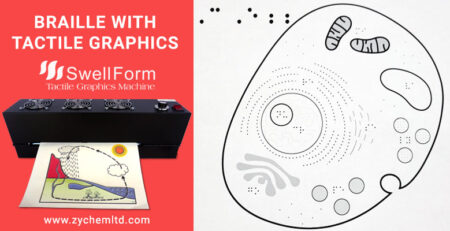
One method of producing tactile graphics uses heat-activated swell paper. Content is printed, copied, or drawn onto the paper using black and color inks or toner. The paper is then passed through a Swell Form machine, where controlled heat causes the black areas to expand while colors remain flat.
Zychem manufactures its proprietary Swell Touch paper entirely in-house and also manufactures the Swell Form and Swell Form Pro machines used to process it. The standard Swell Form machine supports on-demand tactile graphics, while the Swell Form Pro is designed for organizations requiring faster output at production scale.
For a broader explanation of the technology, read What Is Swell Touch Paper? and What Is a Swell Form Machine?.
Choosing an Appropriate Production Method
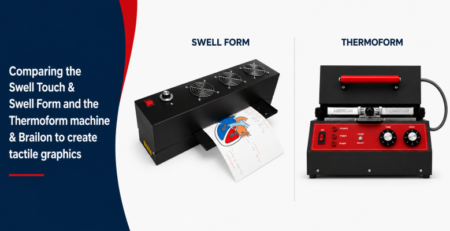
Heat-activated swell paper is one of several methods used to produce tactile graphics. Other methods may include thermoforming, embossing, collage, raised-line drawing, and three-dimensional models.
No single method is appropriate for every application. The right approach depends on the intended audience, quantity, durability requirements, available equipment, production schedule, and professional guidance relevant to the material.
For an overview of different methods, visit Swell Paper vs. Other Tactile Graphics Methods.
Understanding the Role of Zychem
Zychem specializes in the equipment and materials used to produce heat-activated tactile graphics. The company manufactures Swell Touch paper, Swell Form machines, Swell Form Pro machines, and Swell Touch markers.
Zychem does not establish tactile graphic design standards, educational practices, orientation and mobility instruction, or professional accessibility requirements. Those decisions should be made by qualified specialists familiar with the users, subject matter, and applicable standards.
Our role is to provide dependable paper and equipment that allow educators, accessibility professionals, publishers, organizations, and families to produce tactile materials efficiently.
Conclusion
Applications of tactile graphics span education, STEM, maps, orientation and mobility, museums, libraries, public information, transportation, healthcare, workplace training, art, and personal use.
Although the subject matter and professional requirements vary, each application shares a common purpose: making visual information more accessible through touch.
To learn more about tactile graphics, production methods, and Zychem products, visit our Tactile Graphics Guides & Resources.