Learn More About Kinesthetic Learning
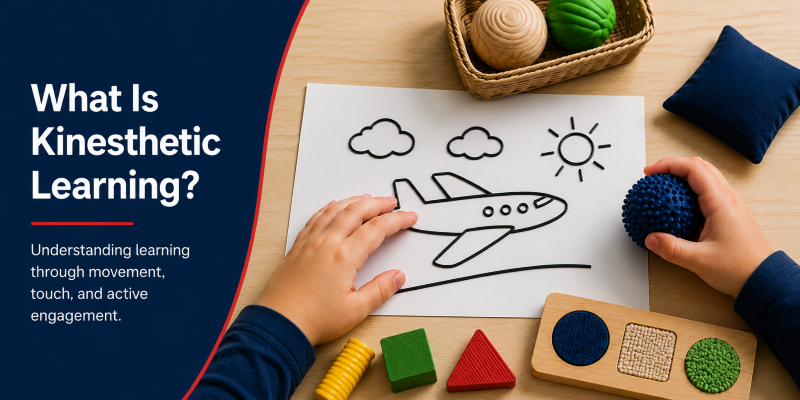
Kinesthetic learning commonly describes activities that involve movement and hands-on experience. Building a model, carrying out an experiment or practising a practical skill are examples. The term is useful for describing activities, rather than a fixed type of learner.
Choose a physical activity when it serves the learning objective. Ask students to explain what they are doing, connect it to the concept and use feedback to improve their work.
Preferences differ between people and can change across tasks. Enjoying practical work does not mean a student cannot learn from accessible text, discussion or spoken explanations. Offer appropriate ways to engage with the same content and check understanding.
Pashler and colleagues’ review found insufficient evidence for matching teaching to assessed learning styles. Purposeful activities and accessible formats remain useful without assigning students to fixed categories.
The Role of Tactile Graphics in Kinesthetic Learning
Raised diagrams provide a way to explore spatial information through touch. This is an important use of tactile graphics.
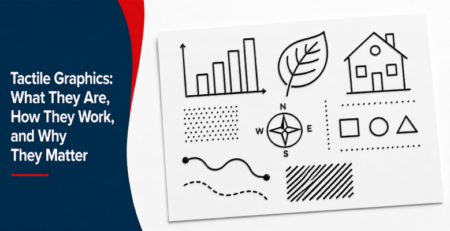
Tactile graphics are raised lines and elements on paper that can be explored through touch. They allow learners to physically interact with concepts that would otherwise be presented visually.
For example, consider teaching the concept of an obtuse angle. When explained verbally or shown visually, this concept can be difficult for some students to grasp. However, when presented as a tactile graphic, the learner can physically feel the angle and understand its structure through direct interaction.
Ask the student to compare the angle with a right angle and explain the difference. Their response provides a way to assess understanding and decide whether more explanation is needed.
Supporting Both Sighted and Visually Impaired Learners
Tactile graphics are valuable not only for students who are blind or visually impaired, but also for sighted learners who benefit from hands-on learning.
For students who cannot access a visual diagram, tactile graphics can provide access to its shape and layout. Sighted students may also use them in appropriate activities, but involving additional senses does not guarantee better memory.
This makes tactile graphics a powerful tool for inclusive education, supporting a wide range of learning needs within the same classroom.
Creating Tactile Graphics for the Classroom
Educators can now create tactile graphics quickly and efficiently using swell paper.
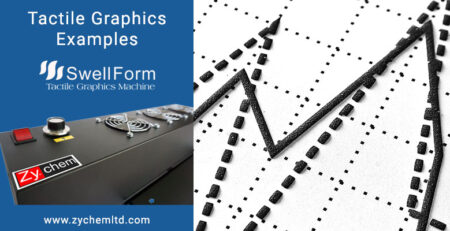
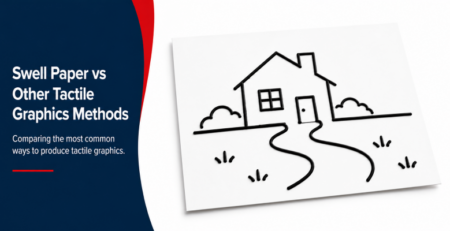
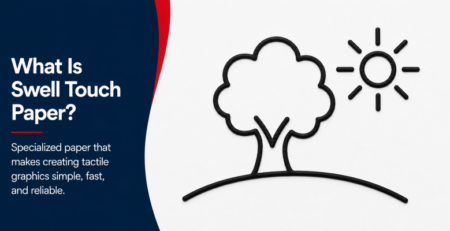
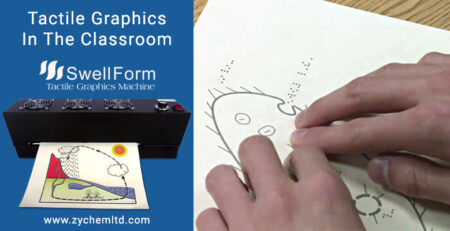
By printing black ink designs onto Swell Touch paper and processing them through a Swell Form machine, the printed areas expand to form raised tactile graphics. This process allows teachers to produce high-quality materials on demand without specialized tooling or long production times.
Provided by American Thermoform and Zychem, Tactile Library offers links to downloadable graphic collections, specialist guidance and answers to common questions about tactile graphics using swell paper.
Conclusion
Movement and hands-on exploration can be part of a lesson when they help students work with its content. Pair activities with accessible explanations, feedback and opportunities to apply the concept.
By incorporating tools like tactile graphics, swell paper, and a Swell Form or Swell Form Pro machine, educators can create more engaging, accessible, and effective learning environments for all students.