Swell Paper vs. Brailon for Tactile Graphics
Swell paper and Brailon® offer two established ways to produce tactile graphics. Both are used by schools, accessibility organizations, publishers, museums, government agencies, and other organizations to make visual information accessible for people who are blind or visually impaired.
Although both methods create tactile graphics, they use different production processes and materials. Rather than competing technologies, swell paper and Brailon® often serve different production needs, and many organizations use both as part of their accessibility workflow.
This article explains how each process works, how they differ, and how they may complement one another when producing tactile graphics.
What Is Swell Paper?
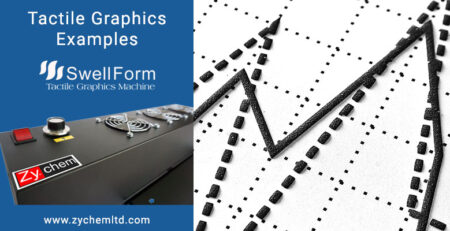
Swell paper, also known as microcapsule paper or capsule paper, creates tactile graphics directly from printed or hand-drawn artwork. Zychem’s proprietary Swell Touch paper contains a specialized heat-sensitive coating that expands when it, along with the black ink, is exposed to controlled heat.
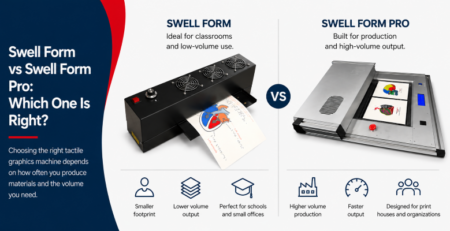
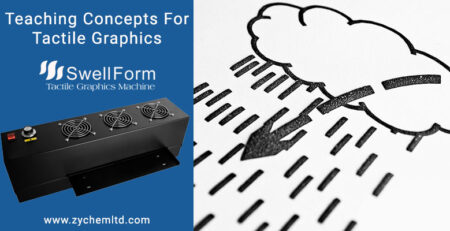
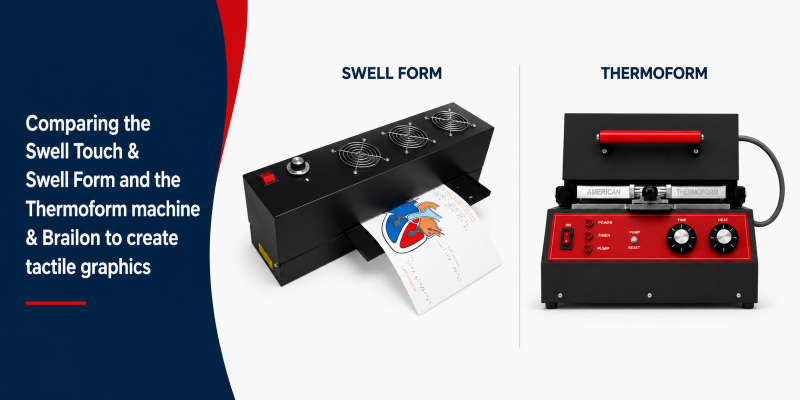
Black printed or drawn areas absorb heat and rise to create tactile graphics while colors remain flat for visual reference. The paper is processed using either the Swell Form machine or the Swell Form Pro machine.
Learn more in What Is Swell Touch Paper?.
What Is Brailon? What Is a Thermoform Machine?
Thermoforming produces tactile graphics by creating an accurate duplicate of an existing tactile master. Rather than printing directly onto specialized paper, a sheet of Brailon® is heated and vacuum formed over a tactile master using an EZ-Form thermoform machine or Maxi-Form thermoform machine.
The finished Brailon copy accurately reproduces the raised details of the original master while creating a durable tactile graphic suitable for repeated use.
How the Production Process Differs
| Swell Paper and Swell Form | Brailon and Thermoform |
|---|---|
| Create or print artwork directly onto Swell Touch paper. | Create or obtain an existing tactile master. |
| Process the paper through a Swell Form machine or Swell Form Pro machine. | Place Brailon over the tactile master in an EZ-Form or Maxi-Form. |
| Heat reacts with the coating and ink to create raised tactile graphics. | Heat and vacuum form the Brailon over the master. |
| The finished tactile graphic is produced directly from the artwork. | The finished tactile graphic is a durable duplicate of the tactile master. |
Creating a Thermoform Master
One of the defining characteristics of thermoforming is that it begins with a tactile master. That master can be created in many different ways depending on the application and the materials available.
Examples include:
- Braille documents
- Raised-line drawings
- String or cord
- Glue
- Embossed graphics
- Hand-crafted tactile artwork
- Layered materials
- Commercially produced tactile graphics
In practice, almost any object or material that creates a suitable raised surface can potentially serve as a thermoform master. Once completed, the master can be reproduced repeatedly using Brailon with an EZ-Form or Maxi-Form thermoform machine.
Producing Tactile Graphics with Swell Paper
Swell paper creates tactile graphics directly from printed or hand-drawn artwork without first producing a tactile master. This allows organizations to quickly create, revise, and reproduce tactile graphics as information changes.
For custom illustrations, classroom activities, workshops, or prototype designs, Swell Touch markers can be used to draw directly onto Swell Touch paper before processing through a Swell Form machine.
Common Applications
Both technologies are widely used to produce tactile graphics for education, accessibility, museums, government agencies, healthcare organizations, publishers, libraries, visitor centers, and workplace training.
Depending on the application, organizations may use one method exclusively or incorporate both technologies into their production workflow.
Explore additional applications:
- Applications of Tactile Graphics
- Tactile Graphics in Education
- Tactile Graphics for STEM Education
- Tactile Graphics for Museums
- Tactile Maps and Wayfinding
- Tactile Graphics in Libraries
- Tactile Graphics in Healthcare
- Tactile Graphics for Government & Public Services
- Tactile Graphics for Visitor Centers & Parks
- Tactile Graphics in Workplace Training
Can Both Technologies Be Used Together?
Yes. Many organizations use both production methods as part of their accessibility workflow.
For example, Swell Touch paper and a Swell Form machine can be used to quickly develop or revise tactile graphics directly from printed artwork. If durable duplicate copies of an approved tactile master are later required, Brailon and an EZ-Form or Maxi-Form thermoform machine provide an efficient way to reproduce that master accurately.
Because the two technologies use different production methods, they can complement one another depending on an organization’s workflow and accessibility requirements.