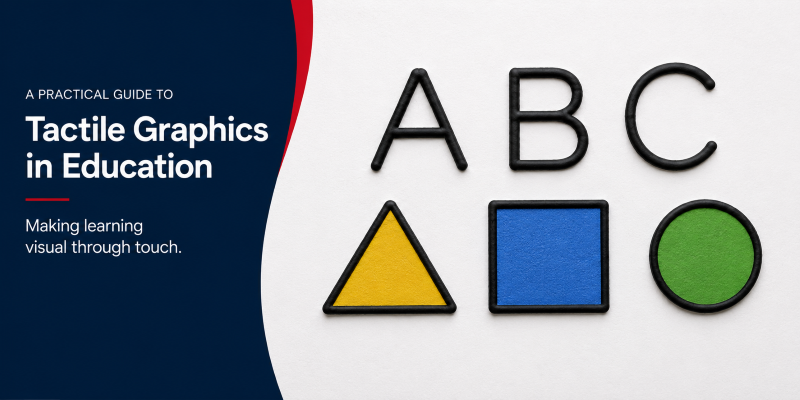
Tactile Graphics in Education
Tactile graphics play an important role in making education more accessible for students who are blind or visually impaired. By converting visual information into raised tactile formats, educators can present maps, diagrams, illustrations, graphs, and other educational materials in ways that can be explored through touch.
Used alongside braille, verbal instruction, physical models, and other accessible learning tools, tactile graphics help provide access to subjects that often rely heavily on visual information. Schools, universities, educational resource centers, accessibility departments, and families all use tactile graphics to support learning across a wide range of subjects.
This article explores how tactile graphics are used in education and the types of learning materials they help make accessible. It is not intended to establish educational standards or replace guidance provided by teachers of students with visual impairments (TVIs), accessibility professionals, or curriculum specialists.
Supporting Accessible Learning
Many classroom subjects depend on diagrams, charts, maps, and illustrations that communicate information visually. Tactile graphics provide an additional way for students to understand these materials through touch while working alongside braille, audio, and classroom instruction.
Educational organizations may produce tactile graphics for individual students, classroom activities, accessible textbooks, examinations, laboratory exercises, and supplemental learning materials.
Geography and Social Studies
Maps are among the most common tactile graphics used in education. Raised maps help students explore geographic features, political boundaries, transportation routes, landmarks, and spatial relationships that would otherwise be difficult to understand without sight.
Teachers and accessibility professionals may also use tactile graphics to present historical maps, population data, timelines, and other visual learning resources used throughout geography and social studies curricula.
Science Education
Science classes frequently rely on illustrations to explain biological structures, chemical processes, physics concepts, weather systems, and scientific data. Tactile graphics allow many of these visual concepts to be presented in an accessible format that students can examine through touch.
Educational diagrams may include:
- Cell structures
- Plant and animal anatomy
- Solar system diagrams
- Weather maps
- Scientific charts and graphs
- Laboratory equipment illustrations
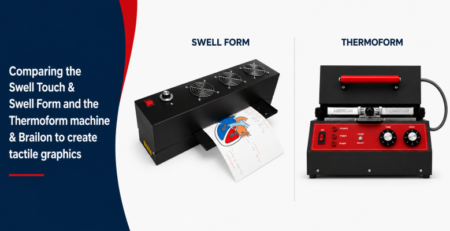
Many schools produce these materials using Swell Touch paper processed through a Swell Form machine, allowing tactile graphics to be created as classroom needs change.
Mathematics and Graphs
Mathematics often involves graphs, coordinate systems, geometry, equations, and visual relationships. Tactile graphics help communicate these concepts by presenting lines, shapes, curves, and spatial layouts in a format that can be explored through touch.
Accessible mathematical materials may include coordinate grids, geometric figures, charts, graphs, and other instructional resources used throughout elementary, secondary, and higher education.
STEM Learning
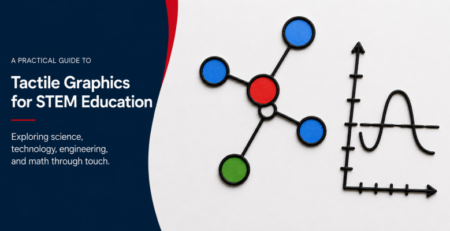
Science, technology, engineering, and mathematics (STEM) education frequently combines diagrams, data visualization, technical drawings, and problem-solving activities. Tactile graphics can support these subjects by making visual content more accessible while allowing students to participate more fully in classroom activities.
Organizations producing larger quantities of tactile graphics may use the Swell Form Pro to increase production capacity while maintaining consistent tactile quality.
Accessible Textbooks and Classroom Materials
Many schools and educational organizations create tactile graphics to accompany braille textbooks, worksheets, classroom handouts, assessments, and individualized learning materials. Because classroom content changes frequently, educators often need a practical way to produce tactile graphics on demand.
Heat-activated swell paper allows updated diagrams, illustrations, and classroom resources to be produced quickly without maintaining large inventories of pre-produced materials.
Higher Education
Universities and colleges increasingly provide accessible educational materials through disability resource offices and accessibility departments. Tactile graphics may be used to support coursework in subjects such as biology, chemistry, engineering, architecture, geography, mathematics, and the physical sciences.
Depending on institutional needs, tactile graphics may be produced internally or through specialized accessibility providers.
Supporting Individual Learning Needs
Every student learns differently, and the appropriate use of tactile graphics depends on the subject, learning objectives, and individual needs of the student. Teachers of students with visual impairments (TVIs), accessibility professionals, and other qualified educators determine when tactile graphics provide the greatest educational benefit.
Zychem manufactures the equipment and materials used to produce tactile graphics but does not establish educational methods or instructional practices.
Producing Tactile Graphics for Education
Many educational organizations create tactile graphics using heat-activated Swell Touch paper. Printed or hand-drawn black areas expand when processed through a Swell Form machine, creating raised tactile graphics that can be explored through touch while preserving color for visual reference.
This process allows schools and accessibility departments to create customized educational materials as lessons evolve throughout the school year.
To learn more about the technology behind tactile graphics, read What Is Swell Touch Paper?, What Is a Swell Form Machine?, and Applications of Tactile Graphics.
Conclusion
Tactile graphics help make education more accessible by allowing students to explore diagrams, maps, charts, graphs, and illustrations through touch. Used alongside braille, verbal instruction, and other accessible learning tools, they support education across a wide range of subjects from elementary classrooms to higher education.
As schools and educational organizations continue expanding accessibility, tactile graphics remain an important resource for providing equal access to visual information while supporting meaningful learning experiences.